Problem
Blockchain technology is built on transparency, but many users desire the ability to transact privately while maintaining the integrity and security of decentralized networks. Ethereum, in its current state, does not natively support private transactions. This lack of privacy can be a barrier to adoption for users who prioritize confidentiality in financial transactions.
Goal
The objective of this proposal is to outline a hybrid on-chain/off-chain system that enables private transactions on Ethereum. By leveraging zero-knowledge proofs and decentralized encrypted messaging, this system provides an effective means of conducting private transfers without requiring specialized wallet infrastructure.
Proposal
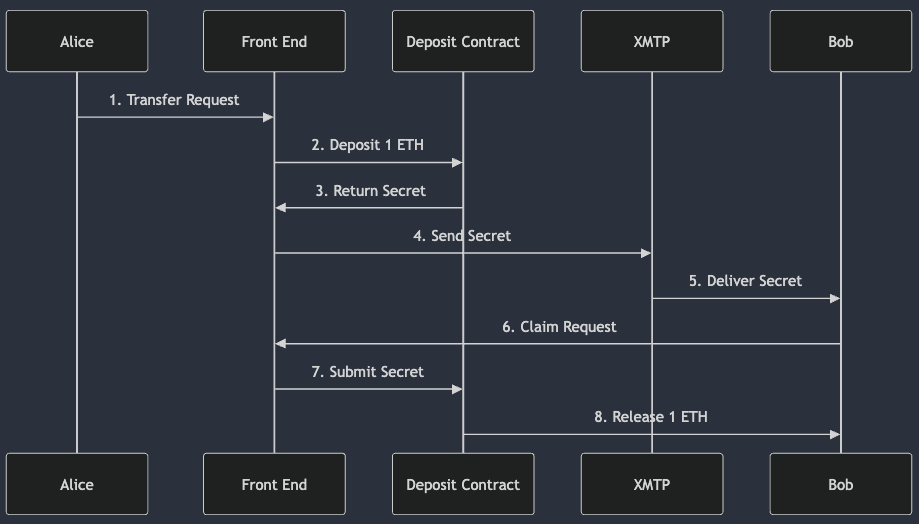
To illustrate the system, consider the scenario where Alice wants to privately send 1 ETH to Bob:
- Alice Initiates the Transfer: Alice accesses a front-end application connected to her Ethereum wallet and initiates a private transfer of 1 ETH.
- Deposit into Privacy-Preserving Smart Contract: Under the hood, the front end deposits 1 ETH into a smart contract that utilizes zero-knowledge proofs, such as Tornado Cash on Ethereum L1 or Veil.cash on Base L2.
- Secret Generation: The deposit contract generates a unique secret, which serves as a withdrawal key for Bob.
- Secure Communication via XMTP: The front end transmits this secret from Alice to Bob using XMTP, a decentralized, end-to-end encrypted messaging protocol.
- Notification to Bob: Bob receives a notification through the front end that 1 ETH is available for withdrawal.
- Bob Claims the Funds: Bob initiates a claim through the front end, which executes a withdrawal from the deposit contract using the secret received via XMTP.
- Front End Submits Secret to the Deposit Contract: The front end interacts with the deposit contract, which verifies the provided secret to authorize the withdrawal.
- Deposit Contract Releases Funds: Upon successful verification of the secret, the deposit contract releases 1 ETH directly to Bob’s wallet.
Benefits
- Seamless Integration with Existing Wallets: The system can leverage Coinbase Wallet’s integration with XMTP, reducing friction for users.
- Multi-Layer Compatibility: The approach works on both Ethereum L1 and Base L2, ensuring broader accessibility.
- AML/KYC Compliance on Base L2: Veil.cash’s verified deposit pools enable optional compliance for regulatory adherence.
- No Specialized Wallets Required: Unlike solutions such as Railgun, this system operates with standard Ethereum wallets.
Limitations
- Fixed Denomination Deposits: Privacy-preserving deposit contracts such as Tornado Cash and Veil.cash generally require transactions to occur in predefined denominations (e.g., 0.01 ETH, 0.1 ETH, 1 ETH, etc.). This constraint could reduce flexibility for users who need to transact in arbitrary amounts.
- Token Holding Requirements: Some privacy-preserving deposit contracts, like Veil.cash, require users to hold a certain amount of their token to utilize the service.